31 October 2023

Days Of The Dead

The dead surround the living. The living are the core of the dead. In this core are the dimensions of time and space. What surrounds the core is timelessness. … The living reduce the dead to those who have lived; yet the dead already include the living in their own great collective.
— John Berger

To understand living we imagine those who once lived.  We see things, grasp feelings, search language for words, titles.  Ghost.  Spirit.  Spectre.  Apparition.  Soul.
We search, we dream, we wonder if they search for us. We, the imagined living.  We conjure, invite or bury for good. Light candles. Enter a procession.  
We may watch the cemetery closely, place flowers, listen for cautionary whispers, blame or thanks. Graves forgotten, watch the bones slide into the river. Escape in flame as atmosphere. Breath. Dust.

We paint.

 NOTES
— John Berger, from Twelve Theses on the Economy of the Dead (1994) collected in Hold Everything Dear: Dispatches on Survival and Resistance (2007) With gratitude for his deep insight and caring.
To understand living (above), a cycle by DB, with gratitude to the ancestors, wherever they may be.
  Photos:  Street Art, Eugene, DB. With gratitude to the artists for enlivening public places. (Click to enlarge)
— Traci Brimhall, The New World from her collection Our Lady of The Ruins (2012) With gratitude for her lucid vision.
 
The New World

We see mountains first. the earth in conflict
with itself. Land of juggernauts, of mummies held
timeless in honey. We make circles around the clouds'

shadows on the ground, careless as wildflowers, reciting
minor revelations and the names of trees we've never seen.
A man builds a theater of snow and ruins it with salt.

A wild girl blunders out of the woods but returns
tearing at her dress and warbling the strange language
of foxes. Hallowed be this squandered country.

Even when we find pyrite in the streams we remain
faithful. Even when the shy wolverines come down
from the hills and carry away the paper birds,

pinned and spinning, above our beds. Still, the dark
forgives the sun its eagerness. The boy forgives the bull
that gored him. We believe because the night after

the birds were stolen, we woke up singing. We heal
whether we want to or not. Whenever we raise
our hands to the sky, they are filled with light.

09 October 2023

Sarah Winnemucca, Northern Paiute

In recognition of the Northern Paiutes on Indigenous Peoples Day, October 9, 2023

Sarah Winnemucca "memorial" sign placed on US Highway 95 as it crosses the Old I.O.N. Road near Rome, Oregon.

Sarah Winnemucca(1844-1891) is … a controversial figure, and herein lies some of her historical interest. … Similarly, her own people, the Northern Paiute, are of mixed opinions about her.  … Neither written history nor oral tradition provides fully satisfactory answers to all aspects of Sarah Winnemucca's life. She was an extraordinary person. She was also a very complex person living in complex times and making complex decisions. She was of two worlds, and perhaps sadly, at home in neither.
— Catherine S. Fowler, from "Foreword" to Life Among the Piutes: Their Wrongs and Claims by Sarah Winnemucca. U Nevada Press, 1994.  
 
Recommended:
— Life Among the Piutes: Their Wrongs and Claims by Sarah Winnemucca Hopkins originally published 1883.
— “ ‘An Educated Paiute woman,’ 1870”  in Oregon Indians: voices from two centuries, edited by Stephen Dow Beckham. OSU Press, 2006.  This includes a brief overview by Beckham and a letter written by Sarah Winnemucca from Camp McDermitt, Nevada, in 1870.
— All photos (click to enlarge) from road trip several years ago after a journey to Map Rock on the Snake River on a 102-degree day. (Yep, jumped in for a cooling dip.)
 
Note
Sacajawea is the most famous Native American in Oregon history. So it is a thought provoking confluence, that her son, Jean Baptiste Charbonneau (1805-1866), who traveled with her on Lewis & Clark expedition, is buried a very few desert miles northeast of the Sarah Winnemucca memorial sign, near remote Danner, Oregon. 


22 September 2023

Artifactual Intelligence

We live in a world that we have not yet learned to look at.
 
   —Marc Augé

See it this way.
  
 —Joan Didion

This is for your convenience. As a courtesy. We anticipate you will soon seek containment.

Your next journey will depart from Omega, travel through Memory to arrive at Alpha. Time may appear to stop for your convenience.
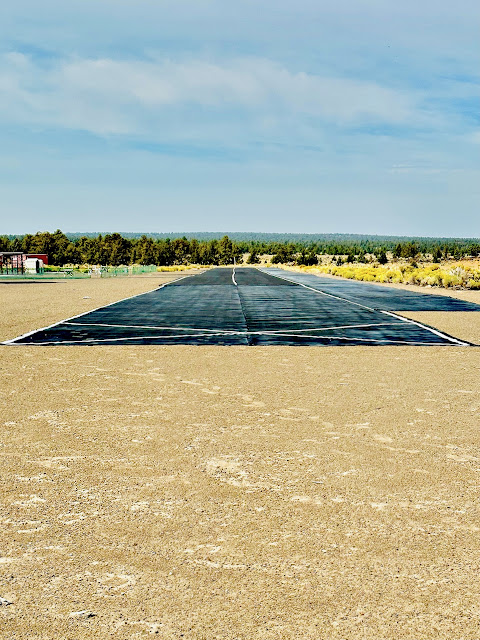
Sign placed for guidance and our convenience. Anticipating your comfort in boundaries. Infrequent radiation monitored by StarLink.
Space for solid waste as yet undetermined. Parameters pending review final decision following. Location for their convenience.
[Ed. note: Pine Mountain Observatory, on the peak in the blue distance, is alarmed at the prospects of Bend's trash trucked and dumped nearby, particulating the atmosphere near the array of finely-tuned, remote-controlled telescopes.]
Exit Artifactual Intelligence at any time by clicking the Runway. Stars may appear, briefly. This is not a fashion show. This is for your convenience.

NOTES
—Marc Augé, Non-pIaces: Introduction to an anthropology of supermodemity. 1992 [1995 Verso trans John Howe]
—Joan Didion, Democracy: A Novel. 1984
—Photos: Dry River country, eastern Deschutes County OR. September 2023. DB.
—Misclaimer: All conveniences appearing courtesy the County Commissioners. Rest, assured. 
 
Marc Augé:
Experience of the remote has taught us to de-centre our way of looking, and we should make use of the lesson. The world of supermodernity does not exactly match the one in which we believe we live, for we live in a world that we have not yet learned to look at. We have to relearn to think about space.
 
Rebecca Solnit, in Hope in the Dark:
History is shaped by the groundswells and common dreams that single acts and moments only represent. It’s a landscape more complicated than commensurate cause and effect. Politics is a surface in which transformation comes about as much because of pervasive changes in the depths of the collective imagination as because of visible acts.
 
SOME LAST QUESTIONS, a poem by Victoria Chang:
 
Will the clock dissolve?
Did rain enjoy falling? Did
the hands truly love me? Did
the treetops know? Was
sadness what we wanted? Were
the fireflies warning us?

29 August 2023

Time Enough . . .

Woodchester Mansion, Clock Tower (circa 1860), Gloucestershire

Remnants of the original Cotswold stone carvings placed on the clock tower of the Woodchester Mansion, circa 1860. The original words entire:

In sapientia ambulate, tempus redimentes (Walk in wisdom, … Redeeming the time). Ephesians 5, 15-16 in the Latin translation from the Koine Greek of the original written Ephesians of the New Testament.

Details of remnants, above.
Below, sheet on window, Woodchester Mansion
. . .  and Time Again

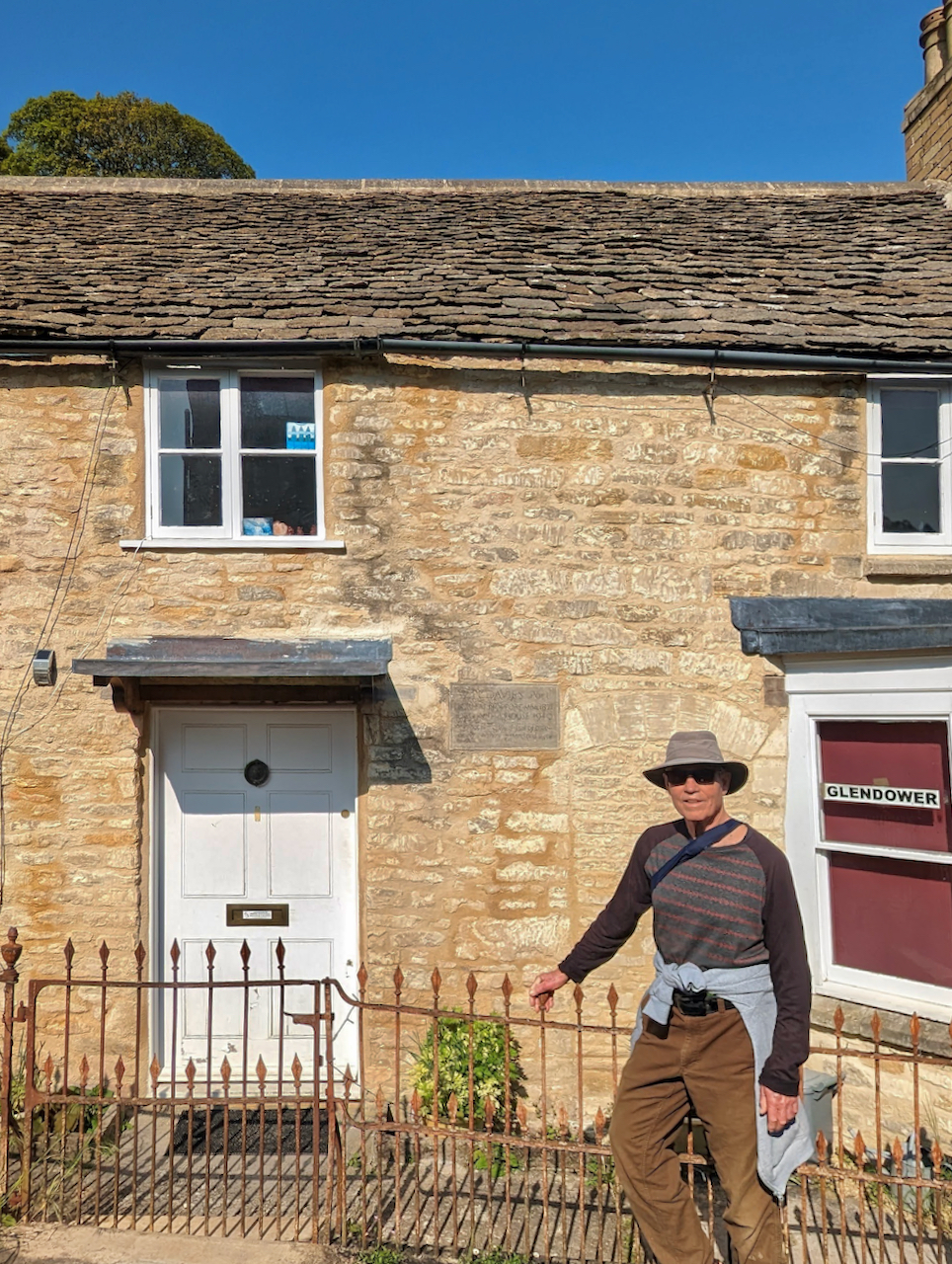
Plaque, Glendower Cottage, Nailsworth, Gloucestershire reads:

W.H. Davies. Poet.
Born at Newport Mon.1871
Died in this house 1940

What is this life if, full of care,

We have no time to stand and stare.

Time to heed 14th-century English poet John Gower? In his Vox Clamantis ("The Voice Crying Out”) he claims, “Scripture veteris capiunt exempla futuri” (old writings contain examples for the future).  

Poet Gower from some eight centuries ago
spins ageless questions:  
Where does old begin and end?
When did or will the future begin?
Does further inquiry convey seriousness
of intent? Indicate avoidance?
(Do line breaks make a poem?)
Cliché to say all the past arrives
in the now exactly as the future begins?
Now itself a gravity, indecent, comforting,
hopeful despair, weightless in abeyance?
Mystically, momentarily, we may speculate:
a vast cycle; born-again as butterfly;
as whale; eternal; depending
on the luck of the draw.
Or belief?
Finally, we inquire: Where now
on the curve of time resides
the ambulating redeeming?
Where lingers the time to stare?

NOTES
— This Inscription post is the second in Gloucestershire. See July 6th: The Relish Bakery stone in Wotton Under Edge

— Woodchester Mansion, Gloucestershire:
https://www.woodchestermansion.org.uk/
https://en.wikipedia.org/wiki/Woodchester_Mansion
— Welsh poet W.H. Davies, a Georgian poet.
https://www.britannica.com/biography/William-Henry-Davies
Davies’s poem Leisure https://en.wikipedia.org/wiki/Leisure_(poem)

CODA
We are told we must worship the body,
In which the deeds of our time
Become veiled by the limiting powers
    of memory.
But only rarely, in the tenderest hours,
Do the tongues of the vanished chime
            In our innermost sanctuary.

— English poet, writer, and natural philosopher Melanie Challenger from Galatea (2006 Salt Publishing)

18 August 2023

Word Is Just A Four-Letter Word

Love on a wall a fence
pressed to concrete.
No getting round it
no easy passing by.
Love generous nervous sharp and new
Fading to resolve.
Love in a word...
Wanton.

CODA
Top Ten?  Consider my Take:
Luck
Fate
Love
Bomb
Hope
More
Less
Live (1. exist; 2. happening now.)
Rhymes with Luck
What?
(OK adding: Give & Take)
 
Online randoms, noting contenders:
Time
Want
Data
Work (no Play)
Top four-letter word in Scrabble?  QUIZ
 
With a bow to Nobel laureate Bob Dylan:
… And I do not really need to be
Assured that love is just a four letter word.

30 July 2023

Why Does Love Got To Be Complicated


We can cry why. We may whisper how.

We say how does Love got? 

The Earth is flat. Right, was all along. If you go to the edge, which you cannot, you fall off.  All the way.  Before, Earth was Water-Immanent. Floating free. No falling. No off. No complicated. Then the Flat. Then the Wall. Next the Mall. Now the Dome. Domicile-domain-complicit.

How Love got to be complicated.

Now we wonder when does Love got to be simple?


Images: Eugene, Oregon, mid-2023 Era of the Human Biologic.