29 August 2023

Time Enough . . .

Woodchester Mansion, Clock Tower (circa 1860), Gloucestershire

Remnants of the original Cotswold stone carvings placed on the clock tower of the Woodchester Mansion, circa 1860. The original words entire:

In sapientia ambulate, tempus redimentes (Walk in wisdom, … Redeeming the time). Ephesians 5, 15-16 in the Latin translation from the Koine Greek of the original written Ephesians of the New Testament.

Details of remnants, above.
Below, sheet on window, Woodchester Mansion
. . .  and Time Again

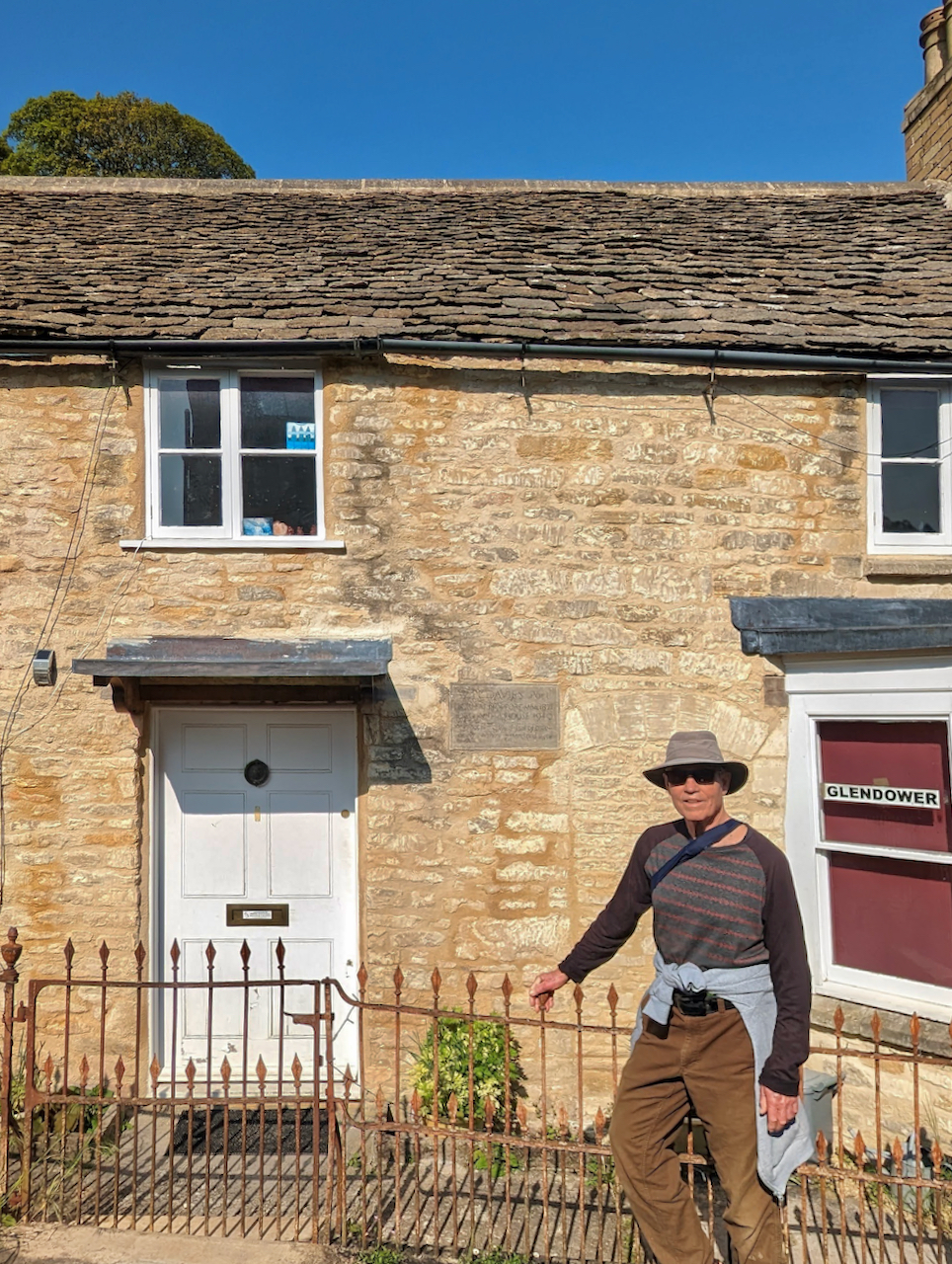
Plaque, Glendower Cottage, Nailsworth, Gloucestershire reads:

W.H. Davies. Poet.
Born at Newport Mon.1871
Died in this house 1940

What is this life if, full of care,

We have no time to stand and stare.

Time to heed 14th-century English poet John Gower? In his Vox Clamantis ("The Voice Crying Out”) he claims, “Scripture veteris capiunt exempla futuri” (old writings contain examples for the future).  

Poet Gower from some eight centuries ago
spins ageless questions:  
Where does old begin and end?
When did or will the future begin?
Does further inquiry convey seriousness
of intent? Indicate avoidance?
(Do line breaks make a poem?)
Cliché to say all the past arrives
in the now exactly as the future begins?
Now itself a gravity, indecent, comforting,
hopeful despair, weightless in abeyance?
Mystically, momentarily, we may speculate:
a vast cycle; born-again as butterfly;
as whale; eternal; depending
on the luck of the draw.
Or belief?
Finally, we inquire: Where now
on the curve of time resides
the ambulating redeeming?
Where lingers the time to stare?
NOTES
— This Inscription post is the second in Gloucestershire. See July 6th: The Relish Bakery stone in Wotton Under Edge

— Woodchester Mansion, Gloucestershire:
https://www.woodchestermansion.org.uk/
https://en.wikipedia.org/wiki/Woodchester_Mansion
— Welsh poet W.H. Davies, a Georgian poet.
https://www.britannica.com/biography/William-Henry-Davies
Davies’s poem Leisure https://en.wikipedia.org/wiki/Leisure_(poem)

CODA
We are told we must worship the body,
In which the deeds of our time
Become veiled by the limiting powers
    of memory.
But only rarely, in the tenderest hours,
Do the tongues of the vanished chime
            In our innermost sanctuary.

— English poet, writer, and natural philosopher Melanie Challenger from Galatea (2006 Salt Publishing)

18 August 2023

Word Is Just A Four-Letter Word

Love on a wall a fence
pressed to concrete.
No getting round it
no easy passing by.
Love generous nervous sharp and new
Fading to resolve.
Love in a word...
Wanton.

CODA
Top Ten?  Consider my Take:
Luck
Fate
Love
Bomb
Hope
More
Less
Live (1. exist; 2. happening now.)
Rhymes with Luck
What?
(OK adding: Give & Take)
 
Online randoms, noting contenders:
Time
Want
Data
Work (no Play)
Top four-letter word in Scrabble?  QUIZ
 
With a bow to Nobel laureate Bob Dylan:
… And I do not really need to be
Assured that love is just a four letter word.

30 July 2023

Why Does Love Got To Be Complicated


We can cry why. We may whisper how.

We say how does Love got? 

The Earth is flat. Right, was all along. If you go to the edge, which you cannot, you fall off.  All the way.  Before, Earth was Water-Immanent. Floating free. No falling. No off. No complicated. Then the Flat. Then the Wall. Next the Mall. Now the Dome. Domicile-domain-complicit.

How Love got to be complicated.

Now we wonder when does Love got to be simple?


Images: Eugene, Oregon, mid-2023 Era of the Human Biologic.


19 July 2023

Stanton Drew: A Celebration

The work of a rock is to ponder whatever is:
an act that looks singly like prayer,
but is not prayer.

As for this boulder,
its meditations are slow but complete.

Someday, its thinking worn out, it will be
carried away by an ant.
 
— Jane Hirshfield, from her poem Rock
One one of the wonders, and perplexities, of megalithic Britain. 
    — Aubrey Burl on Stanton Drew Stone Circles, Chew Magna
 
Contemplating Jeffrey Cohen’s words:
 
To narrate the past conjures possible futures. Stone challenges small, linear divisions of human history through its aeonic insistence. The lithic thickens time into multiple, densely sedimented, and combustively coincident temporalities. Its inhuman scale summons geologic contemplation, extension of story far beyond accustomed durations. 
… To touch stone is to encounter alien duration.
 
Drawing by William Stukeley, the leading antiquarian of the 18th century:
1723. July. 23rd. Stanton Drew.  Somerset.  
The Cove stones and the Church of St Mary the Virgin.
 
The three Cove stones, remnants of a Neolithic chambered tomb, dolomitic breccia (Triassic) transported from a different source and placed 1000 years before the three late-Neolithic stone circles on the Chew River plain to the northeast of the church. 

Today, The Cove stones are encompassed by the garden of the Druid's Arms pub. So it became in May this year we strolled and stared our way in and around the Stanton Drew Stone Circles before partaking of a pint of local cask ale in this congenial garden. While the Stones in patient confidence took measure of their imbibing and transient visitors. One of many rituals witnessed through timeless seasons. 
 
NOTES
Stukeley Festival at Stanton Drew, a celebration on July 22-23 2023 of the 300th anniversary of the visit of the celebrated antiquarian, William Stukeley. 
 
Stanton Drew is the site of the most important stone circles in England, after Stonehenge and Avebury. There are three circles, of which the Great Circle is second only to Avebury in size, and a cove of three stones in the village.
 
Stanton Drew 2010: Geophysical survey and other archaeological investigations Scroll down page to download PDF of this recent study.
 
Aubrey Burl, who died in 2020 aged 93, published around 30 books about prehistoric standing stones of north-west Europe. See: A Guide to the Stone Circles of Britain, Ireland and Brittany (2005, Yale) with some pages devoted to Stanton Drew.
— Jane Hirshfield, from the poem Rock in Given Sugar, Given Salt (2001 Harper).
— Jeffery Jerome Cohen. Stone: The Ecology of the Inhuman (2015 U Minn Press) pp 78, 80.
— Michelle Beauchamp. Sacred Places, Storied Places: Ancient Wisdom for a Modern World. 2013. University of Victoria.  Finding the Way, with Spirit!

Rock

What appears to be stubbornness,
refusal, or interruption,
is to it a simple privacy. It broods
its one thought like a quail her clutch of eggs.

Mosses and lichens
listen outside the locked door.
Stars turn the length of one winter, then the next.

Rocks fill their own shadows without hesitation,
and do not question silence,
however long.
Nor are they discomforted by cold, by rain, by heat.

The work of a rock is to ponder whatever is:
an act that looks singly like prayer,
but is not prayer.

As for this boulder,
its meditations are slow but complete.

Someday, its thinking worn out, it will be
carried away by an ant.
A Mystrium camillae,
perhaps, caught in some equally diligent,
equally single pursuit of a thought of her own.

Jane Hirshfield, in Given Sugar, Given Salt (2001 Harper)

06 July 2023

Inscription: Wotton-Under-Edge

There lives within us all an unspoken dream, a kind of secret belief that something can exist that will not disappear, an imprint that will endure.—Laurent Olivier

In the early-to-mid 16th century, this stone was carved and laid in a religious building. The original location is unknown. Today the stone is placed horizontally above the fireplace in Relish Bakery on Long Street, the main street of Wotton-under-Edge, Gloucestershire.
 
When I inquired about the stone — 91” in length, 34” in breadth, 4 1/2” thick —the info sheet (below) was kindly provided by the Relish Bakery owner. I asked to photo; the Relish Bakery owner graciously pulled back dangling cords.

The inscription:

Hic ia(ce)t Marger(y) Mershe
Que obit Quarto Die Mensis Jan
Anno D(o)m(in)i
Millino CCCCC Ivi
Cuie anime p(ro)picietur Deus
Amen.
 
Here lies Margery Marshe
Who died the fourth day of the
month of January in the Year of
Our Lord, one thousand, five hun-
dred and fifty six
On whose soul may God have
mercy. Amen.
 
In the centre of the cross are the letters I H S, the first three letters of the name of Jesus in Greek.

Details (click to enlarge):
— “The people of Wotton in the mid-16th century had strong Protestant leanings. Isabel Denny was burnt for her faith in Old Town in 1555.”
— “Could such an obviously"Catholic" stone have been displayed openly in the main street of Wotton without causing censure? but we do not know when it was first put on display.”
 
NOTES
— Laurent Olivier, The Dark Abyss Time: Archaeology and Memory (2011); trans Arthur Greenspan
Relish Bakery, Helen Woodward & Sophie Trull, 36 Long Street, W
otton-under-Edge, Gloucestershire.
Wotton-under-Edge — Name from Timeline:   Year 940: King Edmond’s Charter mentions Wudetun (the settlement in the wood). Year 1086: Domesday Book shows Vutune as a dependency Of Berkeley. 
 
CODA
I boarded the local Stroud-Woodchester bus a fine May morning this year intrigued by the Wotton name. As was revealed as we descended the Cotswolds escarpment — the Under-Edge — into a sharp valley leading to the Severn plain north of Bristol. Also, curious about a rural 12th century church with a Norman-era tower, an unusual irregular hexagon, a three-mile upcountry walk east of town up-and-over-the edge to the Ozleworth Estate. St Nicholas of Myra’s Church, a consecrated church no longer in use (redundant) open to the public, though clearly with infrequent visitors. Photo: Interior ceiling of tower.


24 June 2023

Ogee, or Line of Beauty


"To speak merely of a wall of slaty stone which gradually curves inwards gives but a very inadequate idea of the exquisite beauty of the stone and curve alike. There are no marks of tooling, but the evenness of the outer surface is perfection, and the curve, rounding to the entrance, is faultlessly constructed in Hogarth's line of beauty, known to architects as ogee."
— Algernon Gissing writing in 1924 about Belas Knap Long Barrow, a late Neolithic stone-chambered tomb-mound near Winchombe in Gloucestershire.

Gissing references William Hogarth. In his 1753 book The Analysis of Beauty: Written with a view of fixing fluctuating ideas of taste, Hogarth briefly references the ogee, an ornament in architecture, as waving lines. He illustrates precise “line of beauty” with an illustration, indicating 4:
 
“Though all sorts of waving-lines are ornamental, when properly applied; yet, strialy speaking, there is but one precise line, properly to be called the line of beauty, which in the scale of them * (in Fig 49) is number 4 lines 5,6,7,by their bulging too much in their curvature becoming gross and clumsy; and, on the contrary, 3,2,1,as they straighten, becoming mean and poor.”
John Ruskin in 1851, however, opens wide the wide-open eye:  "The varieties of the ogee curve are infinite."
 
"Serpentine" does, however, appear in Hogarth's volume dozens of times with positive acclaim, extending the curving line of beauty and becoming, as Ruskin observes, infinite.
 
The Neolithic builders may have understood how carefully placed stones embodied the infinite; the assured and precise S-curve of the wall Algernon Gissing admires: “the exquisite beauty of the stone and curve alike.”
NOTES
— Ogee, or, in full, ogee curve: a shallow S-shaped or double curve. — Oxford English Dictionary
— Algernon Gissing, The Footpath Way in Gloucestershire (1924), p.47
— John Ruskin, Stones of Venice (1851), I. x. 126
— William Hogarth, The Analysis of Beauty: Written with a view of fixing fluctuating ideas of taste (1753), p.47

PHOTOS at Belas Knap, June 2023, Douglas Beauchamp. With convivial appreciation to Rodger Williams, a self-described Celt and a long-time resident of Gloucestershire, who led the way Belas Knap.

CODA
Why should high material development seem so inevitably to divorce us from the soul of beauty which pervades the natural universe? — Algernon Gissing, 1924